A Dichotomy of Doubt
The #amwriting nightmare, as composed by countless fraught souls:
Me, shortly after writing: THIS WRITING IS GLORIOUS. ITS LYRICISM AND DEPTH WILL CAPTIVATE THE SOULS OF MY READERS AND RIVET THEM TO THE FOLLOWING 100,000 WORDS AND ELEVEN SEQUELS AND TWENTY-TWO NOVELLAS.
Me, rereading the day after:
Last Sunday I had an interesting conversation with another writer who shared these thoughts in the same way I’ve seen on Twitter hundreds of times. The difference I noticed within that short conversation was startling:
I’ve never felt that way about writing. Like, ever.
In the conversation I brushed my lack of self-doubt off to my massive ego (which I hold very dear to my heart), but in reality I felt like the situation had a bit more subtlety to it. Whenever writers shared their insecurities this way online, it always felt fake or hyperbolic to me. I never actually believed anyone could despair about something they felt confident about only a few hours earlier. I thought the crippling self-doubt writers faced was a catch-phrase or “ha-ha,” inside joke.
Aaaapparently it’s not. That short conversation brought the understanding that maybe--JUST maybe--I might be immune to an anxiety and doubt so many writers find to be their greatest challenge.
But, why?
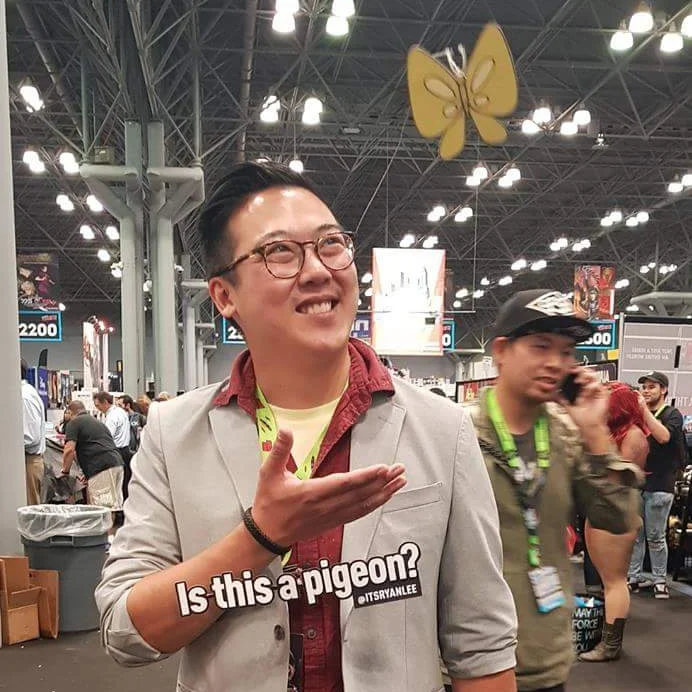
Yes. Yes this is a Live-Action Meme from #NYCC. Photography Credit: @moogzontheloose. Model Credit: @itsryanlee
Plausible Reason #1
Maybe I’ve been coddled my entire life and told I was a great writer so much I just believe it as par for the course.
Hm. I’ve never won a writing competition even though I submitted to one every year starting in 6th Grade and moving into my early 20s. My family consistently told me I was not particularly good at writing, but I had supportive teachers here and there. The publications I have are with small, non-paying journals and years imbetween each one. Besides being white and physically okay, my greatest privilege in life has been getting books from the library, which pretty much anyone can do, and getting to go to college and study poetry for me BA, which I did while relying on quite a bit of scholarships.
Since that doesn’t seem to fit, let’s analyze the symptoms this abnormality has developed:
I’m not been afraid to share writing with other people unless it is extremely personal.
When I receive critiques, I press into the harsher comments and ask for specifics.
If confronted with a direct roadblock (ie. comments from sensitivity readers that say, “This is not okay,” or from respected professionals, “This does not work.”), my imagination goes into hyperdrive. I never come up with more exciting ideas than when I am faced with massive challenges.
Maybe, based on all these symptoms, I’m a masochist? But considering how I can’t finish The Wire because it makes me too sad or how much I complain when I put alcohol on a paper cut, it’s unlikely.
If my privilege and my symptoms all seem to point in different directions, I need to find the intersection.
Plausible Reason #2
Self-doubt comes in different shapes and forms to different people based on their backgrounds and personality.
For many, doubt seems to be the monster that chases after them while they pursue perfection. But for me, my head has always been the monster. Outside of my privilege, I come from a unique background. Take a bit of depression, a pinch of oppression, and a few handfuls of childhood trauma and you’ve made yourself a witches’ brew of self-destructive mental health issues that I get to carry around for the rest of my life. Not to mention the first 21 years of my life was shaped around things that I no longer believe are true and the only reason I got out of the pain of that existence was because of… doubt.
Doubt opened a door for me to explore a new way of thinking and changed my life forever. In effect, doubt has always been one of my biggest tools to weaken the monsters in my head and survive. It’s been the “What if?” to my predisposition towards self-destructive choices, crushing shame, body dysmorphia, and oppressive defeatism. With a healthy combination of doubt, a change in my environment, the right medication, and tools provided by mental health professionals, I’ve managed to fight for myself in a way that I would not have thought possible ten years ago.
This isn’t the way it is for many with mental illness. Maybe it’s because I was raised seeing possibility in seemingly impossible things: angels who become demons, stars that become crowns, a person made of three people, water that could become wine, life after death, and even my namesake who gave birth to a child when everyone said she was barren.
Who knows? Life is weird.
So what do I do when I face doubt? What can I offer writers who struggle with it?
First, I do not dismiss it out of hand. I look at the shape of the doubt, see what it offers me. If it looks too much like the monster in my head, I turn away from my computer and rescue myself with other means. I take long walks. I drown it out with music. I read beautiful books. I pet my cat and close my eyes. I sleep. But if doubt approaches rationally, with a hint of possibility and new ideas, I let it stay with me for a while as I do these things. I let it marinate as I work through the pages I need to write.
When I am able to use doubt appropriately, it feels more like wiping a slate clean than it feels like failure. Destroying your own art, even if it doesn’t quite work, doesn’t mean that work wasn’t honest or true or lovely. It just wasn’t right at that moment in time, with those other words. Once I spent a week watching Tibetan monks as they spent hours and hours of each day creating a brilliant mandala out of sand. The moment they wiped it away was so powerfully beautiful, it just made sense to me. For once in my social media-addicted life, I put down my camera and simply experienced it, knowing even the photographs I took would disappear in time.
Change is inevitable. So is doubt.
The way a person writes only changes with practice and time, but belief is an inconstant, malleable thing. It can shift in a moment or stay true for a generation or grow between the space between words or the space between atoms in a finger pressing against a key. Doubt is key to creating change, but it does not always have to be negative change.
Sometimes, it can make impossible things true.
Ultraman is awesome.